Written by Zane Willman, Associate Advisor | CCG Real Estate Advisors
A lot of people say they want to buy real estate. But that phrase covers five or six completely different bets, each built for a different kind of investor. Each asset class behaves in a unique way, and it's important to distinguish what type of property is right for you and your goals.
Single-family homes are, in essence, an appreciation bet.
FHFA's data going back to 1975 puts the long-run national appreciation rate around 4.3% a year. Which, is even more powerful once you layer in leverage on a 20% down payment.
$1M property. 20% down ($200k). That's your property averaging ~$40k a year in appreciation.
Renting out a single family home rarely covers the mortgage on its own in most markets. But what you're really in a Single Family House for is growing your equity.
Condos flip that logic for a specific buyer: the person trying to get their first investment into real estate.
HOA dues absorb major expenses like the roof, landscaping, exterior paint, etc. The stuff that eats away at a single-family owner's cash flow in year one.
That trade means lower entry price, shared maintenance burden, but HOA governance you can't control. Which is why condos function less as an investment thesis and more as a stepping stone.
Condos can be seen more as a vehicle that gets a buyer into ownership before they trade up.
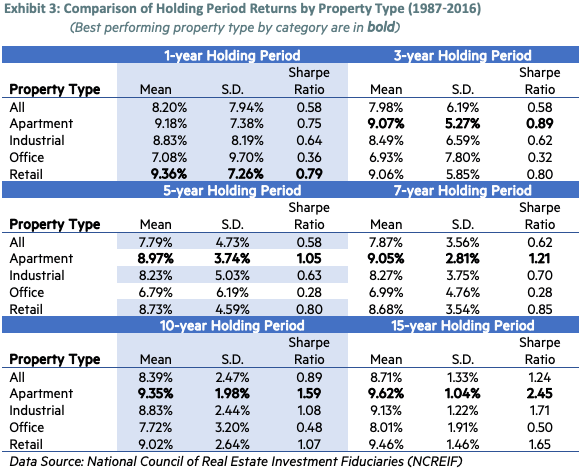
Multifamily is where income, appreciation, and security blend.
NCREIF's 2025 full-year data put multifamily returns at 5.3%, sitting between retail's 6.8% and office's 3.4%. But the composition of that return is different. A seven-unit building spreads vacancy risk across seven leases instead of one.
Plus there's the case for multifamily being the most recession proof. CBRE's data on the 2008 crisis shows multifamily rents declined the least of any commercial asset class and recovered the fastest afterward.
NAR's 2025 buyer survey put the first-time homebuyer share at a record-low 21%, with the median first-time buyer now at 40 years old — up from 28 in 1991.
Everyone needs somewhere to live, and fewer of them are buying it.
Retail is interesting.
It led NCREIF's traditional property types in overall returns for 2025 at 6.8%
During COVID, the retail sector really struggled because malls and large shopping centers basically became ghost towns. There was talk that "retail was dying". But grocery anchored, necessity based centers have continued to perform.
Retail commonly runs on triple-net (NNN) leases which has the tenant paying property taxes, insurance, and maintenance directly. Meaning owners don't have to be as actively involved in the day-to-day operations.
Lease terms are typically longer also. 10, 15, sometimes 20-year terms with built-in rent bumps are standard for anchor tenants.
Industrial has its moments.
Vacancy sat around 7% in mid-2026 and NCREIF's 2025 return came in at 4.5%, solid but nowhere near the runaway numbers of 2021–2022.
What it's still great for is a specific kind of investor: the one who wants a long lease, a tenant who pays the taxes and insurance directly, and basically nothing to manage. If multifamily is for someone who wants to run a small business, industrial is for someone who truly wants "mailbox money".
Then there's Office.
18.4% vacancy at the end of 2025, the lowest NCREIF return of the bunch at 3.4%.
Largely because of COVID, this asset class stopped the traditional culture of how people lived and worked.
The money in office right now isn't in passive investing. It's in buying a struggling building cheap and turning it into something else. Investors are scooping up empty offices at a discount and converting them into apartments, cashing in on the housing shortage instead of waiting on the office market to recover. While Class A office in a larger metropolitan city is still a great investment play, office has converted to a developer's game.
Cap rates show exactly this passivity-and-safety premium at work. As of mid-2026, per CBRE's Cap Rate Survey and Colliers' Q2 2026 data:
- Industrial: ~5.0–5.2% core (up to 6.5% for older/big-box or secondary markets)
- Multifamily: ~5.2–5.6%
- Retail: ~6.4–6.9%
- Office: ~7.4–7.9%
- Hospitality: ~8.5%
Knowing which asset class fits where you are is what creates a portfolio that lasts over time. If you're weighing whether a specific property type fits what you're building, we're happy to walk through it with you.
Sources:
- Federal Housing Finance Agency (FHFA) House Price Index, 1975–2025 long-run average
- NCREIF Property Index (NPI), full-year 2025 sector returns
- CBRE, national office vacancy, Q4 2025
- Kidder Mathews / JLL, U.S. industrial market data, mid-2026